N way anova
# N-way ANOVA
N-way ANOVA can be used to determine the effects of two or more (between-subject) factors and their interactions on a (dependent) variable.
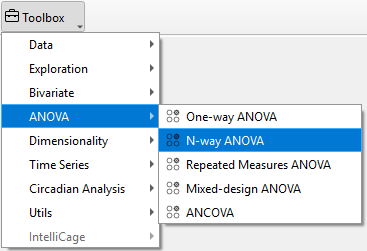
To perform N-way ANOVA (Two-way ANOVA, Three-way ANOVA, Four-way ANOVA, …) in TSE Analytics, select the respective data set from the Add widget and choose N-way ANOVA. Select two or more factors from the Factors list and choose a variable from the Dependent Variable list. If needed, select a P-values adjustment method or adjust the Effect size type via the dropdown menu. Click Update to calculate results and apply changes in the analysis settings.
Analysis result tables for N-way ANOVA include:
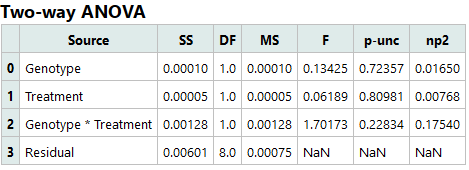
N-way ANOVA (Two-way ANOVA, Three-way ANOVA, …):
- Source: Factor names or interactions
- SS: Sums of squares
- DF: Degrees of freedom
- MS: Mean squares
- F: F-values
- p-unc: uncorrected p-values
- np2: Partial eta-square effect sizes

Pairwise post-hoc tests (only for two-way ANOVA):
- Contrast: Factor (= independent variable) or interaction
- A: Name of first measurement
- B: Name of second measurement
- mean(A): Mean of the first measurement
- std(A): Standard deviation of the first measurement
- mean(B): Mean of the second measurement
- std(B): Standard deviation of the second factor group
- Paired: Indicates whether the two measurements are paired or independent
- Parametric: Indicates if parametric tests were used
- T: T statistic
- dof: Degrees of freedom (only if parametric=True)
- alternative: Tail of the test
- p-unc: Uncorrected p-values
- p-corr: Corrected p-values
- p-adjust: p-values correction method
- BF10: Bayes Factor
- effect size type: Effect size as defined in “Effect size type” dropdown menu
Note
N-way ANOVA is only performed if at least one animal is assigned to each possible combination of groups.
Pairwise comparisons for N-way ANOVA are only performed for two factors (Two-way ANOVA). The pairwise comparisons table is not displayed for N-way ANOVA with more than two factors (Three-way ANOVA, Four-way ANOVA, …)
Pairwise comparisons for two-way ANOVA are only performed within the factor which is listed first in the Factors list. The order of factors can be reversed by clicking on ‘Name’ in the header of the factors list.
Example Interpretation
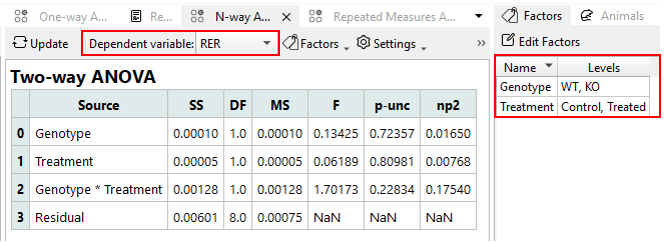
In this example, RER was selected as the dependent variable and analyzed using a Two-way ANOVA with the following two factors:
-
Genotype: WT / KO
-
Treatment: Control / Treated
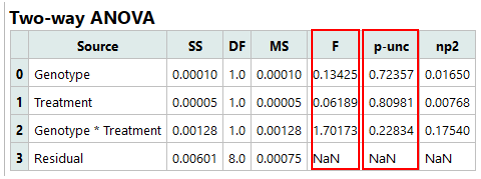
1. The first table summarizes the Two-way ANOVAtable includes the F-values and corresponding p-values for each effect:
-
Genotype main effect: not significant (p = 0.725): WT and KO animals show no meaningful difference in RER.
-
Treatment main effect: not significant (p = 0.808): Control and Treated groups have similar RER values.
-
Genotype × Treatment interaction: not significant (p = 0.228): The treatment effect does not differ between WT and KO animals.
All p-values are well above the 0.05 threshold, indicating that neither factor nor their interaction has a significant impact on RER. Effect sizes (partial eta-square, np2) are also small, supporting the same conclusion.
2. The second table shows pairwise post-hoc tests, which further compare the means of the individual groups. This allows checking whether any specific pair of conditions differs from another.

-
Mean differences between groups are very small
-
All p-values are > 0.05
-
Effect sizes (Hedges' g) are low
-
Bayes Factors (BF10) do not support evidence for group differences
So, the post-hoc comparisons confirm the ANOVA results: RER values are similar across all four groups, with no significant differences detected.
Together, in this example, both the Two-way ANOVA and post-hoc tests indicate that RER does not differ significantly across genotypes or treatment conditions, and there is no significant interaction between these two factors.